No time to blog at the Summit
Friday, October 7th, 2011The Presentation was great. But there was little time left to blog while attening. I did take plenty of notes – I will attempt to share some here once I get a chance to review them
Good Meeting Communications = Successful Organizations
The Presentation was great. But there was little time left to blog while attening. I did take plenty of notes – I will attempt to share some here once I get a chance to review them
An actual email last night at 10:11pm to eSlide:
“Russ, We’ll call you in a few minutes to discuss the edits here.
FYI – I may or may not be heading to the hospital with my wife who is expecting our 2nd child any day now. Please send all of the updates requested going forward to me and Andrew when they are done so that if I’m not here, he’ll get them.”
Then at 11:51pm in response to sending him his requested edits:
“Thanks Russ. At hospital so I’ll touch be tomorrow.”
We have yet to hear from him this morning if the baby was born or if he has more edits. This is not the first time we’ve received an email from a client in the hospital and probably will not be the last. It is an example of the intensity of some of our clients and how seriously they take their work.
This person is an analyst for the executive team of a major healthcare company. He and his team are preparing presentations for their upcoming yearly analyst meeting. They do not take this opportunity to present to an important group of analysts lightly.
We have been working with their executive team for years and we know they fully take advantage of the power of excellent PowerPoint visuals to connect with their audience, tell their story effectively, and insure the meeting does not just tell of their success but contributes to their future success with excellent communication.
The pressure of an important PowerPoint production sometimes feels like we’re helping a client give birth to a baby. I’ve always said all the late night productions for me were great practice for the sleepless “baby feeding and diaper changing days”. Now that my kids are way beyond that stage,
A good article on meetings in The New York Times: JOBS | September 26, 2010
Career Couch: Staying Professional in Virtual Meetings
By EILENE ZIMMERMAN
Virtual meetings have become a staple of business life, but personal conduct during a phone or video conference can be different than in face-to-face meetings.
Eilene Zimmerman hits on some important points about staying professional in Virtual Meetings from the perspective of being a participant. I totally agree that virtual meetings are now a staple of the business world. One key point she left out about virtual meetings . . . you need to pay even more attention to your PowerPoint visuals – that’s if you are using them. As Eilene points out the visual component of your virtual meeting is important. Read the rest of this entry »
I love a good meeting! But I guess I’m just a meeting maniac. It makes me crazy when people make blanket statements about meetings. Today I read “How NOT to Have Mind Numbing Office Meetings” by one of my favorite Social Media Gurus that I follow @ChrisBrogan. He suggests that no meeting should last more than 10 minutes. I guess he would never last in one of my management meetings that sometimes last for 10 hours. Yes, I said 10 hours!
I believe that one of the reasons for eSlide’s success is that we take meetings very seriously. We’re a small company but rarely, if ever have a meeting without a plan or objective. There have been very few meetings in our 10 year history that did not include a written agenda. If there are complex challenges to be discussed and decided on, I attempt to include detailed notes.
One of our management challenges has always been that we are so busy assisting clients prepare PowerPoint slides for their critical meetings (the focus of our business), that finding time to meet with my three partners is nearly impossible some weeks. Client meeting deadlines always seem to get in the way of our own meeting plans.
We attempt to have weekly meetings but schedule a monthly 4-6 hour management meeting. During the first few years of our start-up phase, we met from 2pm until whenever. These meetings often lasted 10+ hours. They were sometimes intense, often exhausting, but we had an agenda of items to discuss that ranged from reviewing our budget to discussing new marketing materials, to personnel issues. Certain items were just for discussion to get everyone’s input and other items were to get a group consensus and make critical decisions.
Individually, each partner (and staff member) has strengths that contribute to eSlide’s success. We communicate all day with phone calls, emails, and an online chat application but there is nothing that beats the group brain power of a well planned, focused meeting.
Maybe we learned the importance of the power of a good meeting from years of assisting executives in some of the largest, most successful companies in the world in developing their PowerPoint slides that have acted as visual information guides to their critical meetings – whether it be a board meeting of twenty or a company wide meeting of 1000’s, or the launch of a new product to millions. They often have staff preparing for weeks, sometimes months in advance for these meetings, planning every detail that can be planned, because so much of a live meeting is dynamic and unpredictable, but is also where some brilliant ideas can arise or be launched into action.
Although it seems they often forget to plan the time it takes to develop, design and produce the important PowerPoint visuals – which goes back to the reason it is hard for us keep our own meeting schedule, but since we see every day the powerful results of a good meeting, we remain totally committed to making the most of our own limited, but very valuable meeting time whether it’s 10 minutes or 10 hours.
PowerPoint is not the enemy, but can be a powerful communication secret weapon, if used well.
If you were in a contest to win a million dollars by pitching an idea to a small group of investors for starting a new company which would you choose:
1. Send them a detailed 100 page business plan a week before the meeting and ask these extremely busy investors who have their own successful companies to run and a few too many start-up businesses to oversee and keep tabs on – to read your detailed plan. Then at the pitch meeting with them, speak to a few highlights of the plan and ask them if they had any questions. What do you think the chances are that they read your detailed business plan or anything beyond the summary page – if they even took the time to look at more than the title?
2. Send them the detailed 100 page business plan and ask them to review it. Then you meet with them and take the first ten minutes to present the key highlights of the plan with some powerful, effective, easy to understand PowerPoint visuals that support your presentation speech. You make sure they knew you expect them to ask questions at any time. You brought copies of the detailed business plan, so you could answer some questions by pointing them to answers in the document (that they probably forgot to bring, or lost in the pile of plans they are asked to review). You might have an appendix of the plan in the PowerPoint deck with all the key data that you might be asked about and can quickly show supporting data to answers if asked about it.
Creating this PowerPoint deck might take a lot of work. I might even hire a professional graphic artist to assist with a few of the key graphics. In the end it will ensure that I get the opportunity to present my idea thoroughly and accurately by having the long form detailed document, my speech, and powerful visuals to point out the highlights and support the words in my speech.
For an opportunity to win a million bucks to get my business started, I’d do what ever it takes to ensure my one shot at pitching it to the investors that could make it happen. I’d use every tool available to me.
Now, if I were in the military and presenting information on strategies and information that may change the course of history and literally result in the life or death of people, not just the financial success of a company – I would use every available tool to communicate that information as effectively and accurately as possible!
If used effectively, maybe the bullet points in a PowerPoint used by the military could actually save lives by avoiding the use of real bullets that kill people.
Financial crisis, Healthcare crisis, and now Mideast crisis all caused by PowerPoint. The horrible program that has tortured millions, maybe billions of people to sit through boring, time wasting meetings.
Faster than a speeding locomotive, able to leap from any size digital projector or computer screen, more powerful than a nuclear bomb, capable of killing ideas and making people stupid, PowerPoint is the secret weapon of the Microsoft Bill Gates to conquer the world.
Forget Microsoft Word, Excel, Outlook, Explorer and all the other applications the evil Microsoft has forced upon the world with their near monopoly of the software industry, it is PowerPoint that is being used to control minds and make people stupid enough to buy the next Microsoft Office release and add billions of dollars to his already fat financial world controlling bank accounts.
Once people start using the new features in PowerPoint 2010, they will become so stupid that they will start believing FOX News is truly unbiased news reporting. These people made stupid by PowerPoint 2010 will then start voting into office people like Sarah Palin and Glenn Beck (who are too smart to ever have used PowerPoint). Once in power, they will ban the use of Google search of their backgrounds, tax The New York Times out of existence, and heath care for anyone over the age 65 to save costs.
They will then push through congress and the senate a new law that allows them to appoint a new leadership position of the US, the Czar of the Digital US. Everyone will know, even the people made stupid by PowerPoint, that the Czar that controls the Internet, the computer “clouds”, the virtual worlds, the digital US will control the world. Bill Gates will have won. PowerPoint is the enemy. We must fight back with long winded speeches without any visual support, and 100 page research papers that everyone must read or die, for there will be no summary PowerPoint decks to help get the key points communicated. We must stop this enemy now!
Inspired by the article in the NY Times: “We Have Met the Enemy and He is PowerPoint“, The New York Times, April 26, 2010 by Elisabeth Bumiller
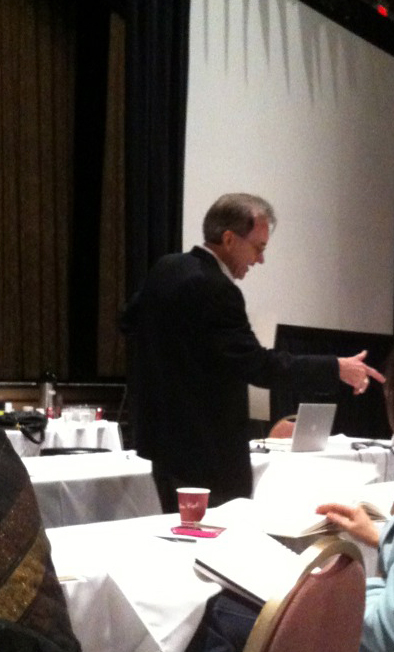 I recently attended Edward Tufte’s full day class “Presenting Data and Information” for the second time. I enjoyed it just as much as the first time and highly recommend it for anyone in the business of designing and producing presentation visuals. If you don’t know who Edward Tufte is, he is the master of Visual Data Design. Last week President Barack Obama announced that he would be appointing Edward Tufte to the independent panel that advises the Recovery Accountability and Transparency Board. Tufte is being asked to help design the government web site www.recovery.gov, which will chart how every single dollar of the $787 billion stimulus bill is being spent. A Newsweek article on his appointment, calls his data visualization “the clearest, richest interactive database ever produced by the American bureaucracy”.
If there is anyone that can take on the monster task of taking the tons of government dollar data of the recovery act and turn it into visually appealing and most important understandable information for a mass audience, it is Tufte. I only wish the government used Tufte or one of his followers to put the healthcare chaotic mess into some easy to understand visuals so the voting public could actually understand what is going on or maybe even help our politicians understand what exactly they really voted for.
Tufte is amazing how he can take a boat load of complicated data and turn it into a simplified, accurate visualization that communicates the data tracking results effectively. In today’s world of infinite information overload, this talent is in high demand. Tufte is well known by anyone in the business of presenting data and information, or at least he should be. Don’t hire any professional presentation designer if they can’t tell you they are familiar with some of Edward Tufte’s principles of data and information design.
Although, be careful of “professional presentation designers” that buy into his anti-PowerPoint message. He spews anti-PowerPoint insults to anyone in his class that admits they use PowerPoint. I believe it has been a great marketing ploy. He broke out of his circle of academic fame into the public eye with his essay “PowerPoint Does Rocket Science–and Better Techniques for Technical Reports” where he claims PowerPoint is partly responsible for the Columbia spaceship disaster. From this essay, the “DEATH by PowerPoint” term was born and the Anti-PowerPoint movement was launched. Data visualization is not by any means an interesting topic of mass appeal, but PowerPoint, the tool of millions, if not nearly every professional and amateur presenter, is an easy target to attract mass appeal. With PowerPoint shows being viewed by millions and millions of audiences around the world every day, every hour, every minute, who can not say they have not viewed more than their fare share of bad PowerPoint slides? Tufte’s “Death by PowerPoint” message hit home to the millions of people who regularly are forced to sit through boring presentations and BAD PowerPoint produced slides.
Yes, I will admit PowerPoint has probably contributed partially to the Columbia Spaceship disaster, but in the same way a knife contributes to the killing in the latest murder on last night’s news. But it is only a tool, you can’t hold the knife responsible for the murder! When used appropriately, a knife can carve a delicious turkey, or help carve a beautiful sculpture. PowerPoint is just a communication tool. In Tufte’s essay all he proves is that the decision makers used the tool wrong or maybe should have used a different tool such as a long detailed technical engineering report and not relied so heavily on summary slides.
In my view, Tufte’s essay actually proves how POWERFUL a PowerPoint presentation can be in shaping opinions and moving people to decisions. Unfortunately in the case of the Columbia incident it was used poorly, and resulted in a bad decision. BAD PowerPoint can lead to bad decisions. It can do this by inaccurately focusing the audience on wrong information and in most cases just “kills” the the communication at the meeting, which almost always results in causing more problems.
PowerPoint can be a great tool when used correctly. I have personally seen it happen hundreds of times – how a good PowerPoint deck has helped communicate critically important messages that have impacted millions of lives for the better by changing the courses of large and small companies for the better. I have seen great presentations with the help of powerful PowerPoint visuals close billion dollar corporate deals and help raise millions of dollars at a single charity event.
Edward Tufte, a data guru, professor with a passion for very large sculptures, you’re famous now. You’re making millions. Please give up on the anti-PowerPoint marketing message and acknowledge the reality that it is just a tool and if you use it well (and this includes using many of your principles of good data visualization), it can be a great tool for presenting data and information. One day maybe you’ll read and agree with my essay “Life by PowerPoint”.
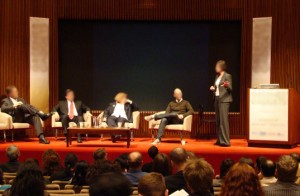 I attended a conference recently that was 50% Panel Discussions vs 50% Presentations. Panel Discussions seem to be part of the “Anti-PowerPoint” trend. I believe the Panel Presentations “trend” is because they are easy to organize, require little planning, ofter exposure to plenty of willing volunteers who claim to be experts in their field, they’re promoted as being more interactive than a “presentation”. And most of all, Panel Discussions at events are a trend, because it’s easier for conference organizers to get people to present on a panel, because they don’t have to fear “Death by PowerPoint”, since most panel discussions I’ve seen lately don’t use PowerPoint slides.
Personally, I often find them boring and a snore fest. How good the panel performs as a group often depends on how skilled the leader is at facilitating a panel discussion. It also does take some speaker skills to be a participant on a successful panel. At this particular event the panel participants seemed to be bored with each other. As one person on the panel talked, the other four people looked bored and uninterested what the others were saying. They just seemed to be waiting for their opportunity to promote themselves as experts and soft sell their businesses.
There was one group that had the good fortune of a terrific facilitator. He asked great questions, kept the conversation going back and forth between all panelists, even asked the audience for some questions to the panel. He listened to answers and played off the particular expertise of each panelist. He seemed like he knew his panelist – maybe did some preparation before the event and researched his panelist or even spoke to them before their time on stage.
What does it take to have a successful Panel Presentation? First be sure the leader of the group has experience facilitating good group discussions. If you are a facilitator of a panel discussion, do the group and audience a big favor, spend some time researching who is on the panel (if you don’t know them already), and have some prepared questions. Your questions don’t have to be used, but good to have if the flow of worthwhile info goes off into a wild tangent or stops.
If you are a participant, you should also research your fellow panelist, and facilitator. It would help if you contact the panel leader to find out what type of questions he/she will be asking. Pay attention when others are speaking, look at them, even if you have to pretend being interested in what they are saying. It appears rude and selfish if you are sharing the stage, but looking as if you are bored to death or checking your text messages on your cell phone. Being on a panel obviously requires less work than having to prepare a speech and slides, but it should include some preparation work if you want to insure that you appear to be the expert you claim to be and contribute successfully to sharing interesting and helpful information to the audience.
The facilitator and panel participants need to remember the purpose is share information with the audience. It’s not just having the audience observe a group discussion.
Personally, I’d rather see six 10 minute presentations, than 60 minutes of sitting in an audience and observing a group discussion. Yes, you can kill a meeting with a BAD PowerPoint slides, but you can just as quickly kill a meeting with a bad panel discussion.
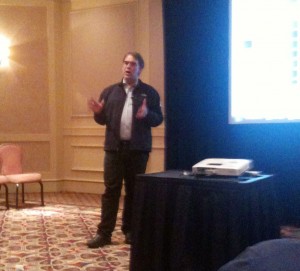
Ric Bretschneider, Sr Program Manager of the Microsoft PowerPoint Team gives a preview of the future of PowerPoint 2010
Just got back from “The Future of PowerPoint” and the next version of PowerPoint looks amazing! I have been trying to get to the PowerPoint Live conference for years and finally made it this year. I will not miss another. The event was everything a good event should be: educational, inspiring, fun and memorable.
The highlight for me was getting to see the new features of PowerPoint 2010 being demonstrated and explained by Ric and Sandy from the Microsoft PowerPoint team. It was great to spend three days with 100’s of other people passionate about PowerPoint and the power of the program when used correctly. There were plenty of examples of really good PowerPoint shows from some of the best in the industry. The only talk of “Death by PowerPoint” was how ridiculous a statement it is especially when you consider all the powerful communication going on when PowerPoint is used effectively.
Cliff Atkinson talked about how PowerPoint producers should avoid being seen as a commodity and focus on “value pricing”. He spoke about his assistance in producing visuals for a court trial that resulted in a $253 million dollar verdict for the client. Cliff also noted how often people in the room produced presentations that were part of successful communications which resulted in millions, if not billions of dollars for the companies they did the presentation design and productions for.
Rick Altman, the organizer of the event uses a tag line that says “making the world a better place, one presentation at a time”. Although the media loves to pickup the negative stories of PowerPoint overload, and “Death by PPT” stories, it is clear from this event that PowerPoint is alive and well, and will be driving successful meeting communications around the world for a long time. The amazing new features introduced in PPT 2010 will make the program an even more powerful tool for creating visuals that support successful meeting communications.
I will write about some of my favorite features of PowerPoint 2010 in future posts, but if you want information now, a great place for information on PowerPoint 2010 is the Microsoft Team Blog. Maybe my next post will be one where I beg and plead with someone on the Microsoft PowerPoint Team to send me a beta copy of PPT 2010. I can’t wait to use it!
 There are not many people that would admit or say that they love PowerPoint. I do. I have been in the business of creating electronic slides (often referred to today as making “PowerPoints”) since 1991. It seems everyone loves to hate PowerPoint. But everyone continues to use it. And too many people abuse it and don’t use it correctly. If PowerPoint is used correctly it can be a great communication tool for getting your important points across to your audience quickly and effectively. You have a better chance of having people remember what you present if you present it with good visual support – with good PowerPoints. I have seen PowerPoint decks that have launched new products, new businesses, new careers, ideas, strategies, and raise millions of dollars for charities, promote environmental causes, explain complicated medical procedures, assisted in winning million dollar sales deals and be a critical communication component in closing a billion dollar merger. Has PowerPoint helped you achieve your meeting objectives?